

Foundation course on GenAI with Amazon Bedrock and Python
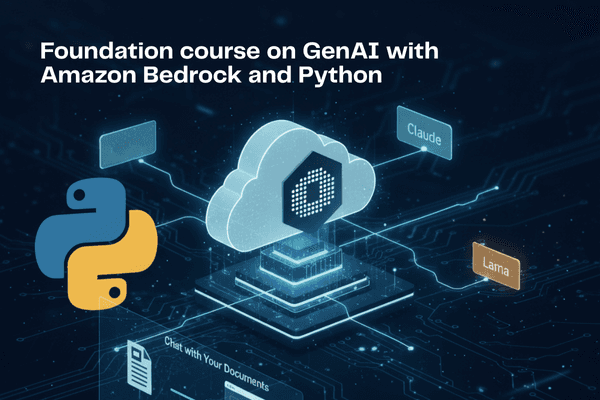
Purpose | To provide a hands-on introduction to Generative AI, enabling the development of practical applications like a "Chat with Your Documents" app using Amazon Bedrock and Python. |
Audience | Developers, Data Scientists, IT/Cloud Professionals, Product Managers, and students interested in applying Generative AI. |
Role | Software Developer, Data Scientist, Cloud Engineer, AI Engineer, Product Manager. |
Domain | Artificial Intelligence |
Skill Level | Beginner (with Python knowledge) |
Style | Hands-on and project-based, culminating in the development of a portfolio-ready RAG web application. |
Duration | 30 hours |
Related Technologies | Python (Boto3), AWS (IAM, S3), Amazon Bedrock, LangChain, Streamlit, Foundation Models (Claude, Llama)Export to Sheets |
Course Description
This foundational course offers a comprehensive introduction to the exciting world of Generative AI (GenAI), focusing on practical application using Amazon Bedrock and the Python programming language. You'll move from understanding the core concepts that distinguish GenAI from traditional AI to getting hands-on experience with AWS cloud services. The curriculum is designed to be highly practical, guiding you through the Amazon Bedrock playgrounds, prompt engineering techniques, and the architecture of leading Foundation Models (FMs). By the end of the course, you won't just understand the theory; you'll be equipped to build, deploy, and manage your own GenAI applications, including knowledge bases and intelligent agents.
Who is this course for
This course is ideal for a wide range of individuals who are eager to step into the GenAI space, regardless of their current role. It's particularly well-suited for:
Software Developers & Engineers: Professionals looking to integrate GenAI capabilities into their applications and workflows.
Data Scientists & Analysts: Individuals who want to leverage large language models (LLMs) and foundation models for advanced data analysis and content generation.
IT Professionals & Cloud Engineers: Those who want to understand how to deploy and manage AI services within the AWS ecosystem.
Tech Enthusiasts & Students: Anyone with a foundational knowledge of programming who is curious about the practical applications of generative AI.
Product Managers: Professionals who need to understand the capabilities of GenAI to drive product innovation.
Course Objectives
By the end of this course, participants will be able to:
Understand Core Concepts: Clearly articulate the difference between traditional AI and Generative AI, and explain the role of Foundation Models (FMs).
Navigate the AWS Ecosystem: Set up an AWS account, configure necessary security permissions using IAM, and use the AWS Command Line Interface (CLI).
Master Prompt Engineering: Design effective prompts for both text and image generation models to achieve desired outcomes.
Utilize Amazon Bedrock: Confidently use the Amazon Bedrock text, chat, and image playgrounds to interact with various FMs and understand their unique parameters.
Architect GenAI Solutions: Explain the architecture of Amazon Bedrock and make informed decisions about choosing models (like Claude, Llama, Stability AI) based on performance, cost, and security.
Build Practical Applications: Develop functional GenAI applications by creating a Knowledge Base and building an intelligent Agent within Amazon Bedrock.
Integrate and Deploy: Combine all learned components to build and conceptualize end-to-end Generative AI solutions using Python.
Prerequisites
To get the most out of this course, you should have:
Basic Python Programming Skills: You should be comfortable with fundamental Python concepts such as variables, data types, loops, functions, and working with libraries.
General IT Knowledge: A basic understanding of how applications work and what cloud computing is.
No Prior AI/ML or AWS Experience Required: The course is designed to introduce you to both Generative AI and the core AWS services needed for the projects, so you can start from scratch in these areas. However, any prior familiarity with cloud platforms will be beneficial.
Course outline
Section 1: Introduction to Generative Al and Amazon Bedrock
What is Al?
What is Generative Al?
Difference between Al and Generative AI?
Understanding Foundation Models (FMs)
Introduction to Amazon Bedrock
Benefits and Use Cases of Amazon Bedrock
Section 2: Intro to AWS
What is cloud and AWS?
Hands-on Lab: AWS Account Creation and Setup
Hands-on Lab: Creating an Admin IAM User for Secure Access
Hands-on Lab: AWS CLI Setup and Configuration
Section 3: Prompt Engineering Quick Intro
What is Prompt Engineering?
Prompt Patterns for LLMs (e.g., Zero-shot, Few-shot)
Different Approaches: Instruction Prompts, Role-Playing, Chain-of-Thought
Prompt Engineering for Text and Image Generation
QUIZ: Prompt Engineering Principles
Section 4: Hands-on with Amazon Bedrock Playground
Tour of the Amazon Bedrock Console
Hands-on Lab: Using the Text and Chat Playgrounds
Hands-on Lab: Using the Image Playground
Understanding Model Parameters (Temperature, Top P, etc.) and Their Effects
Section 5: Deep Dive into Amazon Bedrock
Service Architecture and Core Components
Model Providers and Top Models (Anthropic's Claude, Stability AI, Meta's Llama, Mistral)
Accessing and Using Bedrock Foundation Models
Cost Considerations and Foundation Model Pricing
Security and Governance with Bedrock
Section 6: Building Knowledge Base in Amazon Bedrock
What is a Knowledge Base?
Components: Data Source (S3), Embedding Model, Vector Store
Hands-on Lab: Creating a Knowledge Base from Your Documents
Testing and Querying the Knowledge Base
Section 7: Building and using GenAl Agents in Amazon Bedrock
What is a GenAI Agent? (Reasoning and Acting)
Core Components: Foundation Model, Action Groups, Knowledge Bases
Hands-on Lab: Building a Simple Agent to Perform a Task
Testing and Tracing Agent Execution
Section 8: Building GenAl Applications
Introduction to the AWS SDK for Python (Boto3)
Code Example: Using Boto3 to Invoke Bedrock Models
Code Example: Streaming Responses for a Chatbot Experience
Hands-on Lab: Building a Command-Line Summarization Tool with Python and Bedrock
Introduction to LangChain for Building LLM Applications
Section 9: Putting it All Together
Capstone Project: "Chat with Your Documents" Web App